
I had long awaited arriving at the Falkland Islands to see penguin colonies up close and personal. In fact, I had signed up for a Holland America Shore Excursion eleven months prior to the Volendam’s scheduled arrival on Jan 27. What I didn’t realize at the time was the “if” and the “how” of getting to this remote island located in the South Atlantic Ocean more than 300 miles away from any other land.
I shouldn’t really say “this island” because The Falklands is actually a group of over 700 islands clustered around two main ones, East/West Falkland. I learned that the Port Stanley harbor is not deep enough for a large cruise ship to navigate to the pier, so it needs to anchor in the Bay. Small boats must then be used to transport the passengers from the ship to the dock. However, if winds are strong and the waves rough, those trips may be suspended or even cancelled. About half of the scheduled cruise ships sail past the Falklands if the weather forecast is too dire. So when the ship’s captain made the decision to anchor, I was thankful. I’d get to see penguins!
Before breakfast time, the ship began lowering four of their lifeboats which hang above Deck 3 into the bay to be used as tenders. I walked down the stairway to Deck A, got my ID card scanned, and cautiously walked down the outside staircase that led down to the lifeboat. Crew members graciously helped me step over the entrance of the bobbing boat, and I began the half-hour ride to the dock on rather choppy water along with about sixty others passengers.


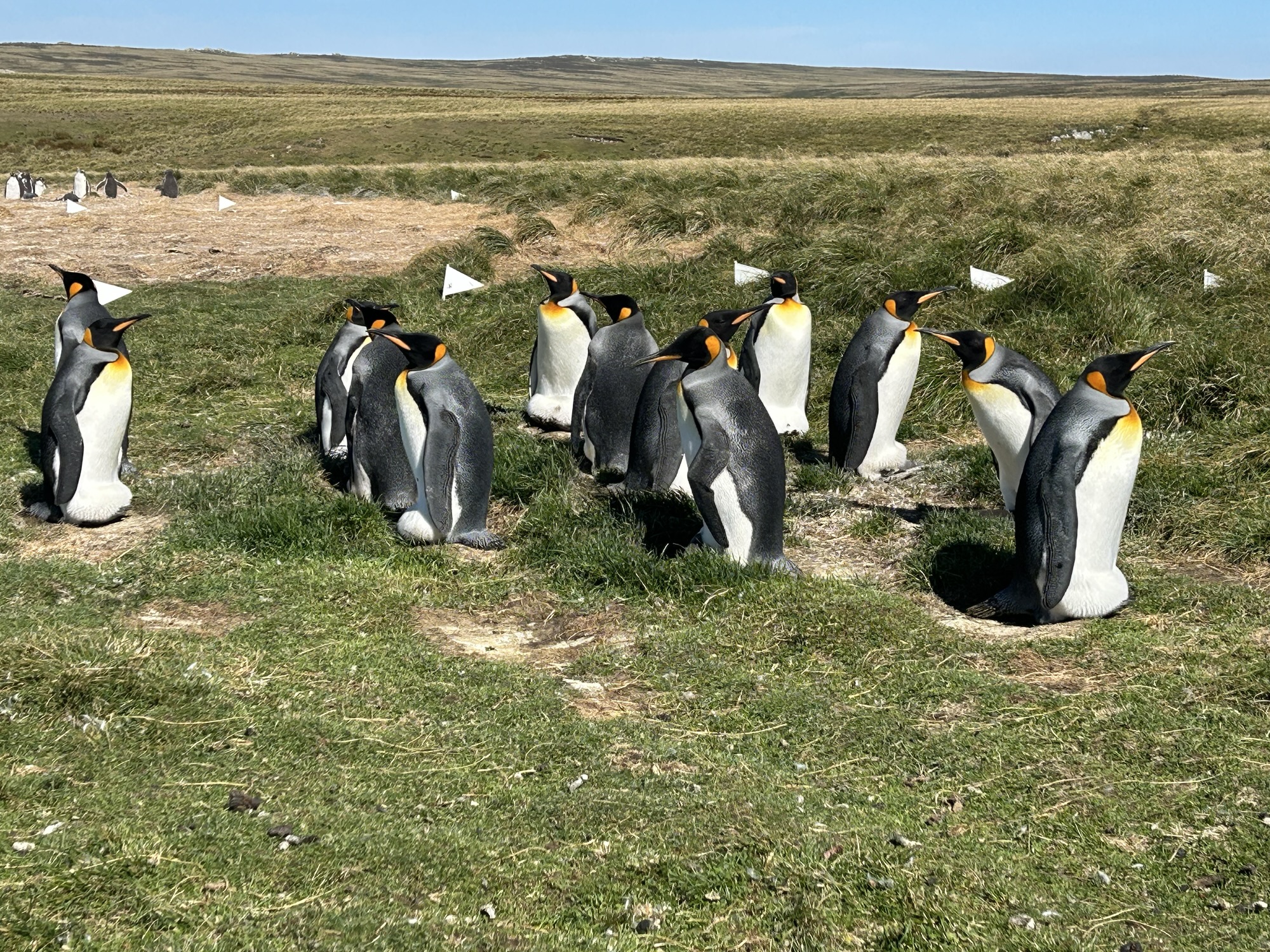
After a 30-minute drive through the rocky landscape, we arrived at Bluff Cove, a family sheep and cattle farm of 35,000 acres. The farm borders on a lagoon which is home to over a thousand pairs of breeding Gentoo penguins, and a growing colony of King penguins. We were dropped off on the hillside where we could wander and watch as long as we stayed behind small white flags placed in the sandy and grassy ground.
I intently watched a group of King penguins who were strutting around and seemed so oblivious to their human audience. I marveled at being so close to these flightless birds whose waddle made me smile. The King Penguins have vivid orange ear and throat patches, and were approximately 36” tall.


Across a large sandy area was a large colony or rookery of Gentoo penguins, and their squawking and chirping to each other drew me over to listen and watch. The Gentoo Penguins have orange-reddish beaks, a distinctive white patch above their eyes, and are a bit shorter than King penguins. Some were resting, and others were strolling over an embankment to head towards the water of the lagoon. I watched, fascinated by their antics and tones of their communication. A few ventured into the water, and their long flippers propelled them fluidly through the water as they searched for food.


I warmed up inside the Sea Cabbage Café next to the museum and giftshop built by the farm’s owners. Sea Cabbage is a wild plant that grows around the area, and its wild, red berries are used to make Diddle Dee Jam.


Everyone visiting the farm is treated to a complimentary tea time, with home baked treats including scones with clotted cream and diddle dee jam.

After a memorable three hours at Bluff Cove, the tour guide dropped us off in Stanley, and I enjoyed meandering around the town for an hour, taking photos, reading signs, and eating a traditional meal of a meat pie with “chips”.

I photographed Christ Church with its front-lawn monument of a whalebone arch made from the jaws of two blue whales in 1933.

As I walked along the harbor front, I spotted two benches commemorating the ten-week war in 1982 between the United Kingdom and Argentina over the ownership of these islands. Argentina invaded and occupied the Falkland Islands, and the British sent their navy to regain control. Almost 1,000 were killed during this conflict before Argentina surrendered. I didn’t have time to visit the museum or cemetery.


During my walk, I met a young lady from the Netherlands who was a sailor on the Tecla, a tall-ship sailing vessel moored at the dock that travels the world. Built in 1915 as a herring fishing vessel, and now family-owned, it specializes in expedition sailings to the Arctic and Antarctic with 4-10 guests and a crew of similar size. I don’t think that’s on my agenda!

A last photo of lupine, one of my favorite flowers, and I was ready to get back on a tender and head back to, as our Captain Rens van Eerten says, “The beautiful, elegant Volendam.”

Leave a Reply