
The port of San Antonio, Chile was an important stop for our ship. It was the end of the first segment of our Grand Voyage, so some passengers not traveling the entire cruise disembarked and others joined us for the next leg of the journey. Of the approximately 1,100 who started out with us in Ft Lauderdale, about 600 are on the ship for the entire 133 days. Others are scheduled to leave or to join in San Antonio, Sydney, Singapore, or Tokyo. And so, we said farewell to a few people we had gotten to know.
The San Antonio port is the gateway to Chile’s capital city of Santiago, and some passengers had scheduled port excursions there. But we opted for a small-group “Tours by Locals” to Vina del Mar and Valparaiso, two cities closer to the port.
Touring Vina del Mar, nicknamed the Garden City, was very disappointing. The guide shared a lot of history as we drove throughout the city, but didn’t make any stops until we finally told him we needed a break. Photos taken through the van window are less than good, so all I am left with is a photo from one of the tourist attractions, The Flower Clock.

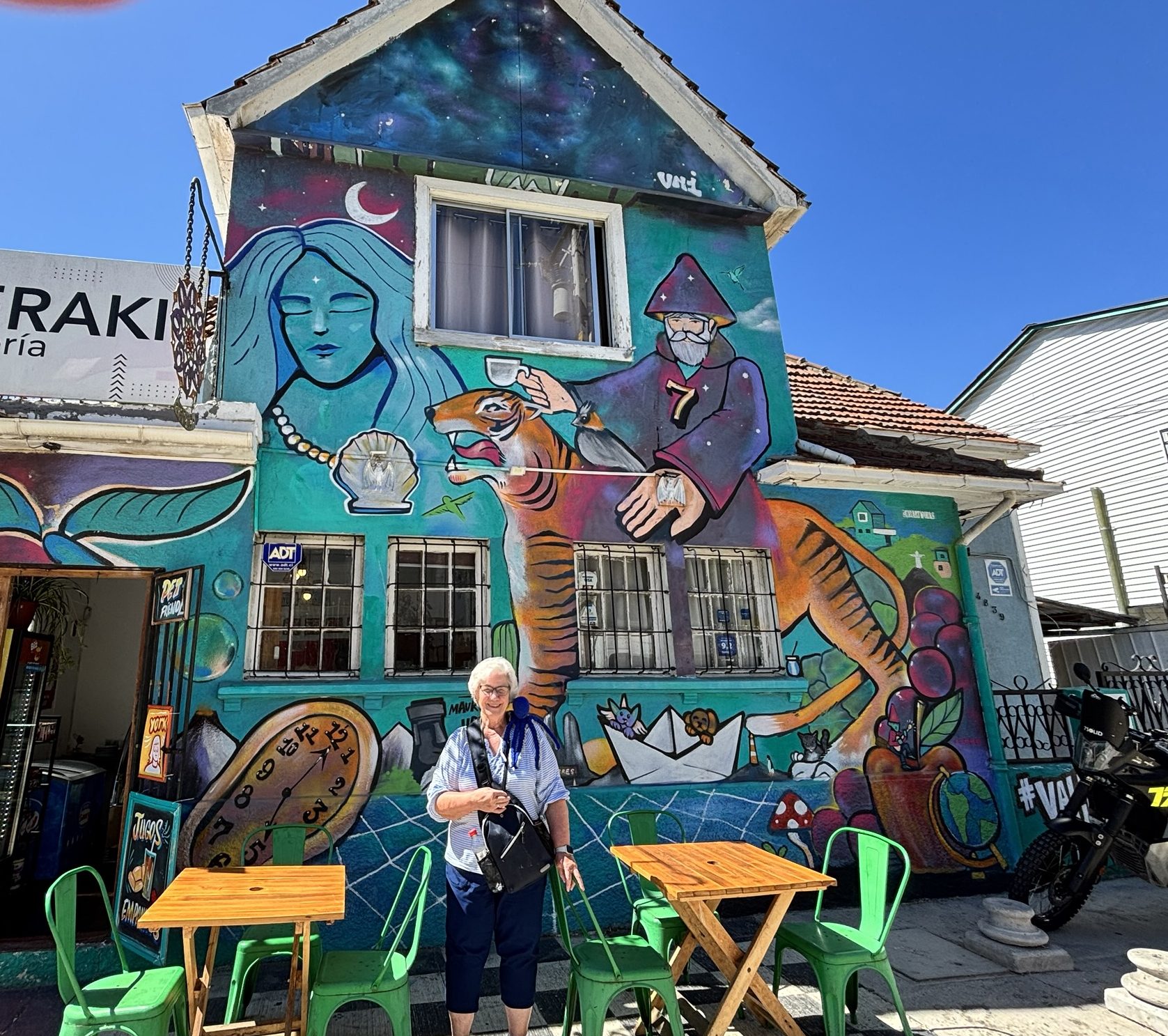
But the tour improved greatly as we arrived at the outskirts of Valparaiso, a city of 320,000 people that is built on 45 steep hills. Its historic quarter is now a UNESCO World Heritage Site. Our tour guide seemed delighted to share the culture and artistry that draws tourists and artists from around the world to enjoy the colorful hillside houses, street art, and murals covering buildings. And, we stopped frequently so we could walk and admire what we saw.


What grabbed my attention the most was how the city responded to graffiti that appeared on many city buildings during the years before the return of democracy. After that pivotal point in history, government officials chose to legalize and support street art, and encouraged artists to create murals to showcase their talents. Soon vibrant murals began appearing on buildings all throughout the city. It didn’t matter if a building was on a main street, a side street, or even an alley, any and every bare wall became a canvas to express an artist’s vision.


As we rode up and down cobblestone streets on the colorful hills, we saw explosions of color everywhere. We learned that some of the artists cover their own costs in order to express themselves through their art. Other times, building owners commission artists to beautify their property which, interestingly, also prevents illegal vandalism. Older murals are sometimes painted over, so there are ever-changing exhibits in this open-air art gallery.


Because the government has encouraged this “artistic graffiti” and even sponsors competitions, the city has become a welcoming place for artists to live, and tourism has increased.
Even the café where we stopped for a snack was a whimsical canvas inviting us inside. I enjoyed a homemade meat empanada along with a latte and a rich, dense nut-torte while sitting on a small balcony overlooking one of the city’s hills.


I never had heard the word “funicular” until we planned this excursion, but now I had the opportunity to ride one. Funiculars were designed and built in the late 1800s to function as outdoor elevators to connect the waterfront with the steep residential hills. Thirty were built around 125 years ago, and fifteen remain in operation today.
Each funicular has two wooden and metal cars, each holding 6-8 people, which are connected by a cable. As one descends down the incline, its weight pulls up the other one so that they pass each other during the 2-minute ride. What an interesting form of public transportation to get people to work! To watch the funicular in operation, see “Video: Valparaiso” in the “Where in the World is Odysseus” section of my web site


Because we were in the Casablanca Valley, well-known for its vineyards and wine production, we stopped for a wine-tasting at Casa Vinamar. The long driveway ended up in front of a large manor, and we could see fields of old and new vines stretching as far as the eye could see. We learned about the wine production as we sampled three kinds along with home-made crackers and rolls.


When we arrived back at the ship, the gangway and the welcoming sign were both in place to welcome us back. While we had been gone, the ship continued its almost-constant maintenance as evidenced by a painter touching up the exterior paint.


I went out onto Deck 3 to look around at all the hub-bub of activity that goes on in a port. Along the pier behind our ship was a container cargo ship stacked with rows of containers. And anchored next to us was a fuel station, a bright-orange vessel with crew members who were filling our ship with 750 metric tons of diesel fuel.


As I walked around the promenade deck and then down to my cabin on Deck 1, I was thankful that my time in port had turned out so well. Graffiti (well, the artistic kind!) and funiculars had made for an interesting day.
Leave a Reply