
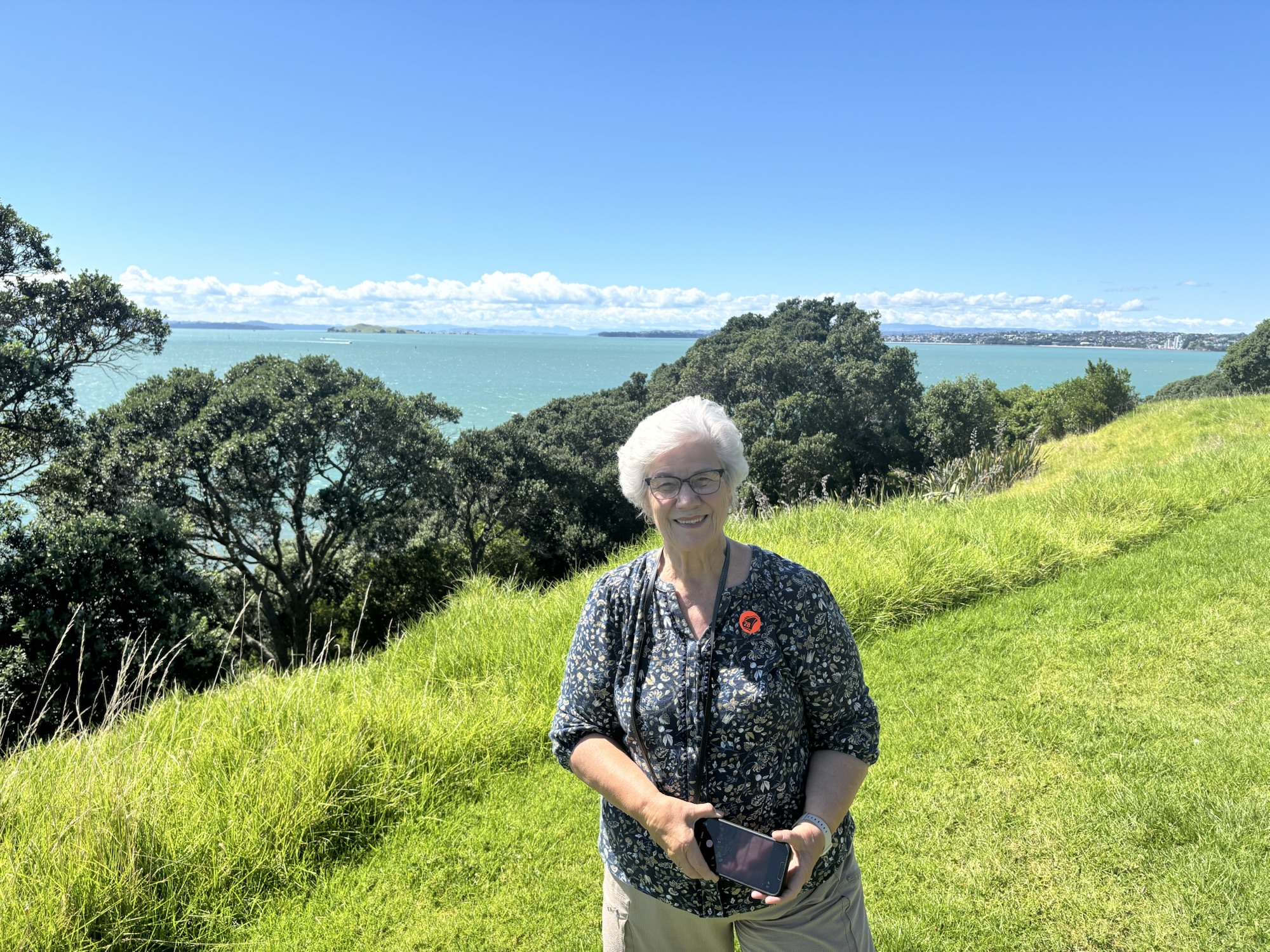
After sailing for five days on a section of the vast Pacific Ocean with no land in sight, I welcomed the view of the Auckland Harbour as we entered through Hauraki Bay. I love “Sea Days”, and hope to post a blog about what those are like for me. But after five of them in a row, it felt good to walk on land instead of through the gently moving hallways of our ship!
We arrived a day earlier than our original itinerary because we skipped the scheduled stop at the island of Tonga. Our captain alerted us when we left Bora Bora that a cyclone was developing around Tonga that forecasted 30’ waves! To avoid that, he chose a different route to get us to New Zealand, which would give us an extra day there.
With two days in New Zealand’s largest city, Auckland, and one in the Bay of Islands area, I experienced a delightful combination of city and suburban life as well as the countryside with a rain forest and cave.
Our ship docked at Queen’s Wharf, right next to the city business district. What struck me immediately about the city of Auckland was how clean it was compared to many of the South American cities I had recently visited. Maybe that’s because much of this business area was built on reclaimed land in the 1950s-1960s so it’s relatively new. 400’ cliffs were taken down and used as partial fill. The result is a modern, beautiful waterfront with shops, restaurants, parks, and businesses.


As I traveled throughout the city itself and the neighboring suburb of Devonport during two days, I learned that New Zealand consists of two main islands, North Island and South Island which are separated by Cook Strait, plus around 600 smaller islands located within 30 miles of the coast. The entire country has about five million people, with 1/3 of them living in Auckland. Interestingly, Auckland is built on 50 volcanoes, all dormant! The North Island is also home to the 117 Maori tribes, indigenous Polynesian people who settled this area in the 1300s. Their society and culture are an important part of New Zeeland still today.
I enjoyed our stop at Maungauika, in the town of Devonport, a volcanic hill which was originally a sacred place for the Maori and later the location of a fort that was part of New Zealand’s defense system from 1870-1996. Walking through some of the tunnels and seeing where the ammunition was kept made the history seem more real.


Sometimes when you roam around a town, you find something unusual. After finding a local pub in the suburb of Devonport for a quick lunch, we noticed a statue of a cat outside the local library. Of course, we had to find out the story behind that! Turns out that Benjamin hung around the old library for over ten years, making himself at home. When the new library was built in 2015, a cat door complete with a flap was made on a side of the building so he had full use of the library day or night. He napped between shelves and followed employees around. When he passed away in 2017, Benjamin the Library Cat got his own statue which is often decorated by the local children.

We stopped briefly at the Auckland War Memorial Museum to hear its history and to see the Cenotaph (empty tomb), symbolic to New Zealanders like our Tomb of the Unknown Soldier. This monument stands on a consecrated spot in front of the museum and is the site for Anzac Day (Day of Remembrance) ceremonies every April 25. It was the bronze wreath overflowing with water that caught my attention, and I reverently stood there reading these words:
“Lest We Forget”
“They shall grow not old, as we that are left grow old. Age shall not weary them, nor the years condemn. At the going down of the sun, and in the morning, we shall remember them.”


I always love seeing and smelling flowers, so our stop at the Winter Gardens was a welcome time of meandering through greenhouses filled with beds and hanging baskets of flowers. It was summer time in New Zealand (Nov – May), but the “winter” gardens were in full bloom. I really liked seeing colorful eggplant and pepper plants, as well as red cabbage, being used artistically in the bed arrangements.


Instead of hiking to the top of the highest peak, Mt Eden, as my niece did, I chose to walk around a bit at a lower spot on the mountain, and enjoy a delicious popular local food, a meat pie. The pastry crust was filled with beef, gravy, and cheese. That, along with a fancy latte, gave me the energy I needed to keep going!


What a windy, beautiful sail-away from Auckland at the end of our second day as we headed out to sail further north around the coast of New Zealand, to the area known as Bay of Islands.


Bay of Islands is part of North New Zealand and incudes 144 islands. Perhaps it is most known for the historic site of the signing of the Waitangi Treaty between Britain and the Maori leaders (indigenous people groups) which was the founding document for New Zealand.
Because we only had a day here, I chose to visit the Puketi Forest and the Glowworm Caves instead of the historic sites. The Puketi Forest is home to the ancient kauri trees, some of which are 2,000 years old. These trees are considered treasures of New Zealand, similar to how we view our redwood and sequoia trees in California. Used by the Maori for centuries to build canoes and later used for lumber, the remaining kauri trees are now protected in government-owned reserves and forests. The trees are known for their smooth, gray bark, their massive girth, and their non-destructible wood.
I followed a native guide through the “Manginangina Kauri Walk” in the forest and learned about the importance of these trees throughout history as well as the conservation efforts now. This includes trapping the various mammals that destroy the roots or spread disease that damages the trees.


We drove through the rolling hills of the North New Zealand countryside, past kiwi orchards, to the small town of Kawakawa (pop 1,600) to see a very unusual tourist attraction!


Can you imagine stopping in a town because of its re-known toilets! That’s what we did! The Hundertwasser toilets are at the center of this town nestled in the open countryside! An artist from Austria (not Australia!) named Friendensreich Hundertwasser designed this “work of art” and useful tourist attraction in 1999. It features irregular ceramic tiles, wavy lines, and colored glass including discarded bottles. Some of the tiles were designed by the local school children. Of course, tourists stopping here enjoy the local bakeries, coffee shops, and restaurants after seeing (and using!) these colorful restrooms!


Our last stop was my favorite of all three New Zealand days – The Kawiti Glowworm Caves. I like caves. In fact, I have hiked in over a dozen of them in the United States, but never have I seen one with glowworms on the ceiling!
Our guide told us the story of the lifecycle of the glowworms while we stood at the entrance of the cave. Eggs are laid by a fly on the ceilings of damp caves, and when the eggs turn into larva, they live for about 9 months during which time they emit a light to attract prey. They create a sticky thread that traps tiny insects to eat. The hungrier they are, the brighter their light. The larvae eventually become a pupa, and then an adult fly. The adult fly lives only a few days just to mate and lay eggs. And the cycle begins again.


We walked in silence into the cave, every fifth person carrying a small battery-powered lantern. The only sound was the stream passing over rocks next to our path. When we had walked approximately 600‘, all the lanterns were turned off. We craned our necks upwards to the limestone ceiling of the cave. Above us were pinpoints of light, over 10,000 glowworms dotting the black ceiling like galaxies in the night sky. It was a breathtaking sight to be sure.
Unfortunately we could not use our cameras in the caves. So these are free photos from the internet.


As I headed back onto the bus for a ride to the cruise port, I reflected on the variety of what I had seen during my three days New Zealand – a large city, lush green countryside, rain forest, and a cave. And what I saw was only a fraction of what I wanted to see. Maybe I should come back sometime!


Leave a Reply