
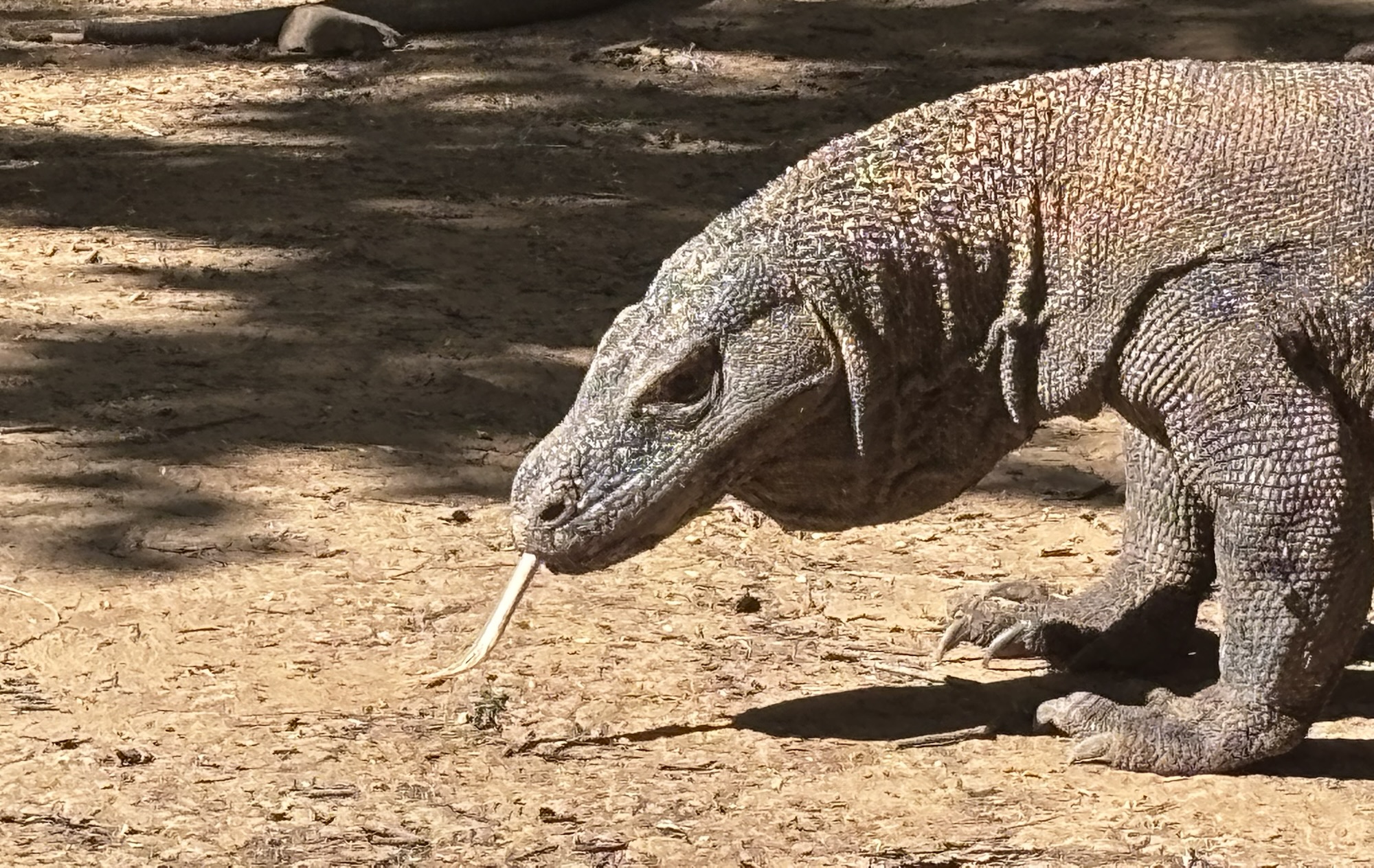
Two challenges faced me as I prepared to go ashore on Komodo Island, one of the 17,500 islands that make up the country of Indonesia. I would have to be able to climb from the tender boat onto the dock at Slawi Bay by walking up narrow cement steps with only a partial handrail. And, I would have to be able to hike for two hours on a narrow path through a very hot and humid jungle forest near the equator. Amazingly, I was able to accomplish both, and the result was a once-in-a-lifetime adventure with living, breathing Komodo dragons!


The entire Komodo Island is part of the Komodo National Park, established in 1980, to protect the world’s largest lizards who live nowhere else in the world. No one can visit the island without a park pass, and every walking tour requires a park ranger plus local “guards” whose job is to protect the hikers from these powerful reptiles.


With our guide leading the way, and accompanied by three guards whose only weapon was a two-pronged stick, we headed out on the narrow dirt path into the forested area. The heat was suffocating, and the humidity made my lungs work extra hard. Our group of 20 was told to travel quietly and to always be on the lookout for movement in the trees and along the path.

I saw my first Komodo dragon about 15 minutes into the trek as he ambled out of the trees and walked along the path. The guards quickly got in front of us to make sure the dragon stayed away, ready to use their stick to prod him in a different direction if he turned our way.
I was surprised at his size and slowness. The guide told us this was not a full-grown male, and it was the lazy time of the day when the giant lizards were soaking up the sun to conserve energy.


As we continued walking, the guide shared that there are about 3,000 Komodo dragons on this island and a few other islands close by. Komodo dragons are actually a species of Monitor Lizards. They are ambush hunters who eat only 12-15 times a year, but they can take down and devour the deer, wild pigs, and water buffalo that also inhabit the island.
Their forked yellow tongue goes in and out to “taste” the air, and it can detect prey miles away with its keen sense of smell. Sometimes, they wait to eat until they smell a carcass miles away, and multiple dragons wrestle each other to “win” the flesh. Other times, they attack their prey viciously with a sudden “grip and rip”, using their 60 serrated teeth to tear the victim’s flesh. Their saliva is venomous, and that incapacitates the victim by causing shock and reduction of blood pressure. This weakens the animal fast and it collapses. Or, if it does escape, the dragon tracks it for miles until it dies from loss of blood. Then the dragon gorges on a feast, swallowing huge chunks of meat in its powerful jaws.


I wondered how this slow-moving lizard I saw could take down a water buffalo! The guide explained that he could run up to 13mph, and use its powerful tail to knock down the large water buffalo. Then he sinks his teeth into the leg of the buffalo, which injects the venom into the deep wounds. Because this venom prevents the blood of the victim from clotting, the prey is soon weakened from blood loss.
That was enough information to remind us that we needed to stay our distance from these docile-looking reptiles, and especially listen to the guards if they yelled at us to move to the side if they were trying to control the direction a dragon was walking! The dragon’s temperament could change in a moment.

Our trek continued slowly until we noticed multiple dragons up ahead. Other hikers had gathered around them to watch them drink from a watering hole and to bask in the sun. Because of where I was standing, I didn’t get any photos by the water hole, but I photographed a few on the surrounding dusty path. One young dragon suddenly darted away from the water and ran under a woman’s legs. Of course, that was exciting!


Watching the dragons at the watering hole gave me a much-needed time to rest my legs and lungs, and to drink lots of water.

Our guide led us to a huge black mound of dirt and twigs and then told us that it was a ground nest of a megapode, a chicken-like bird. What’s so amazing is that the birds lay their eggs in this decomposing mound and the heat incubates the eggs. Then dragons use this same mound to bury their eggs in September, about 20 per dragon.

Only about 15% of the dragon eggs actually hatch the following April. The baby dragons immediately flee up into trees where they live for about 4 years to avoid their cannibalistic parents, as well as other predators. These juvenile dragons subsist by eating insects and rodents.
By this time of the walk, the heat was really affecting me, and I was feeling light-headed. Because we had been warned about the dangers of dehydration and heat-stroke in preparation for this excursion, I had hydrated the previous day by drinking more liquids than normal. And before leaving the ship, I had drunk lots of orange juice and water. It was important to stay with the group so I couldn’t stop and drink, but every chance we stopped to listen or watch, I reached into my “front-pack”, took out one of my water bottles and drank some more. Both in my group and in the one behind us, one of the cruise passengers was overcome by the heat and needed medical assistance to get back to the ship for treatment.
I learned a few more facts about these powerful predators as we finished the hike on the forested path. The adults weigh between 150-200 pounds, can grow up to 10’ long, and some live as long as 30 years. The powerful tail is as long as their body and is used as weapon to knock down prey as well as a stabilizer so they can stand while wrestling another adult. They hiss at each other and thrash their tails around to communicate to other dragons. They can see 980 feet away, but have poor night vision.

When the two-hour trek ended back at the beach area I was hot, sweaty, and tired. But I smiled, feeling so satisfied that I had actually finished the walk and seen these predators in the wild. I smiled even more as I saw this sign and wondered how those dragons knew exactly where to cross the path!

And, at the beach, with our ship in sight, a few more Komodo dragons were just hanging out, their quiet activity a cover-up for the deadly predator they could become in an instant.


As we sailed away from Komodo Island that afternoon, I looked back at the landscape of rugged, hills, grasslands, and forests. I felt I had been in my own Jurassic Park!


Leave a Reply