
Tuna candy. Squid sausage. Cheese milk stick. Stinky tofu. Pork wrapped in fish paste. Tube-shaped fish pasta. Rice blood cake. Squid jerky. Flying-fish roe sausage.

No, I didn’t taste any of those snacks made and sold in an open-air street market I visited in Taiwan! But I did sample some locations and attractions in two areas of this island nation that gave me a flavor of Taiwan.
Taiwan, formerly called Formosa when I was a child, is an island slightly larger than the State of Vermont and lies just 110 miles from the southeastern coast of mainland China across the Strait of Taiwan.
Is Taiwan part of China or not? That is a significant international controversary that has affected government relationships around the world. China claims it is a part of “One China” and the rebellious “province” must be reunified. Taiwan claims it is an independent, democratic country and will not be unified with China.
The Chinese Civil War, between the Communists and the Nationalists (who wanted democracy), ended in 1949 without a formal peace treaty. About two-million Nationalists, under the leadership of Chian Kai-shek, fled to Taiwan while the Communists took control of the mainland.
Now a democracy, Taiwan’s official name is Republic of China (ROC) or Republic of China (Taiwan).
Communist mainland China is officially named The People’s Republic of China (PRC).
That reality of whether Taiwan is part of China or not was an undercurrent throughout my visit as I visited various locations, especially when I heard some comments from our tour guide on the second day.
But let’s get back to my first day, a dreary, rainy day when my niece, I, and another cruise friend ventured out on our own in the port city of Kaohsiung on the southwest coast of the island.
This was our first time using an Uber-Taxi, where we ordered a ride through Uber, but a taxi picked us up. We had planned our own itinerary, but somehow there was a communication glitch, and we rode over an hour to a different religious site than I had expected. The driver dropped us off, and with limited English, said he would wait for us.


We walked into the gate of a massive Buddhist complex of buildings, the Fo Guang Shan Buddha Memorial Center. A large museum and shopping area was in the front of the complex built in a square shape. Behind that was a large courtyard area, with two sides each lined with four pagodas for education and worship. At the end of the park-like courtyard was the world’s largest copper-cast statue of Buddha, 355’ tall towering over the entire landscape.

I will be honest with you. I instantly felt a heaviness, and muscles in my body tensed up. The first thought I had was, “But my God is alive! He’s not dead like Buddha.” You see, the day was Saturday, the day between Good Friday and Easter, and I was excited I could celebrate the resurrection of my Lord and Savior. It pained me to watch people bowing down and worshiping a dead god as I walked closer to that idol.
The rest of our hour there, I pulled inward, going through the motions of a tourist but quiet and reflective as I read some of the Buddhist teachings painted on the inside walls of the open pagodas.

Later, I read why this elaborate shrine was built in 2011; it was built to house a “tooth relic” of Buddha. The museum’s own website says “The goal of enshrining the Buddha’s tooth relic was to create activities that show the Buddha’s compassion and wisdom in a way that people can experience concretely. Through their homage to the Buddha’s relic, people could recognize their own true Buddha nature.”
I’m glad I serve a living, risen Savior!

during my time at this shrine and museum.
When we walked back to the parking area where our driver was supposedly waiting, we were very surprised he was nowhere to be found! No one spoke English, so we used Google translate on our phones to try to get help from various people and drivers in the parking lot. With quite some hassle and lots of gestures, a parking lot attendant called for another taxi for us. Lo and behold, our original driver showed up, no explanation!
We rode in the drizzling rain back to the dock area, where the driver let us off to explore near the port. Some old sugar-storage warehouses, built in the early 1900s and seriously damaged in WWII, had been repurposed into an eclectic group of shops and restaurants.

Then our adventure took a different turn. We headed away from the shopping area, wanting to find a local restaurant with Taiwanese food. We walked and walked and walked, using our Google map and the restaurant icon to find a good place.


Some places on the map turned out to be a “hole-in-the-wall” with cooking happening outdoors in the rain and no indoor seating noticeable. One had a huge line out the door with families waiting to go in to be seated. We got more and more wet as we navigated the streets of Kaohsiung even though we had two umbrellas to share for the three of us. “We’ll find a place around the next corner,” we repeated often to each other.
And then we did! Around a corner, behind a small hotel, we saw a food truck with an umbrellaed picnic table! Somehow, we managed to interpret enough of the menu to place an order and were able to pay with the right Taiwanese coins and currency!


The bench was wet, so we got wet! Our umbrellas collected so much water on top that my niece reached up onto the top of her umbrella and washed her hands in the puddle up there!
Of course, the hot food was yummy, and we declared it a very fine feast! By this time, it was raining so hard, we cut the day short, and called a cab to get back to the ship.

The next day was Easter. Early in the morning, we announced the good news “He is Risen” on our cabin door and then headed for the 5:30am interdenominational sunrise service on the outside sea dock.
As we approached the harbor of Keelung, over 150 passengers, along with and some crew and officers celebrated our Savior’s resurrection with worship songs, scripture readings, and a gospel-centered message by our cruise pastor. I was even in the choir as we sang “In Christ Alone.” What a celebration! The ship provided coffee, juice, and hot-cross buns for us to enjoy on the deck afterwards.


After changing clothes, we headed off on a private, guided excursion along the northern coast of the island with just five of us Even though we were near Keelung (2.7 million population) and Taipei, Taiwan’s capitol (4 million population), we chose to avoid the cities and explore some coastline and small villages.
Our first stop was at an old, closed gold mine near the village of Jiufen. It was here that the guide made an interesting comment about the threat from China that they live under. When he was asked if the gold mine still had gold in it, he responded that his father was one of those who came with Chiang Kai-shek fleeing China in 1949. According to him, Chiang Kai-shek said there was to be no more mining, so that if China tries to take over Taiwan sometime in the future, the Taiwanese would have the gold mine available to buy what they would need to fight.


We walked over to “The Golden Waterfall” where golden-colored water cascades over rocks yellowed over time due to the high levels of arsenic, sulfur, and copper ore leached out of the nearby soil. Some people still believe that the color is caused by pollution from the mining operations, but studies seem to conclude that the color of the water is a natural occurrence. In any case, we enjoyed watching the flowing water.
The waterfalls flow into the Yin-Yang Sea where we could clearly see the yellowish water from the falls and river pooled in front of the blue harbor water.


As we drove to Jiufen Village, our guide told us the history of this village, now a popular tourist attraction. Its name means “nine portions.” Hundreds of years ago there were nine families living in this area, nestled high on a hillside. When a trading group would travel the long distance to get supplies, they would come back with nine portions of everything, and each family would get a share.

This town of 1,600 was packed with thousands of visitors when we arrived. Our guide had earlier booked a parking space and expertly backed into this narrow garage. We walked to the 7-Eleven store and entered a maze of covered alleys and streets not visible from the main road.

but I could hardly get out of the passenger side!


This Jiufen Old Street goes up hill and down, with vertical staircases leading to upper-level ancient streets and alleys. There are old patched roofs covering every walking area so that no sunlight comes in. Multiple red lanterns hung above us as we pushed through the crowds. Our guide explained the various food items we saw and what we should eat when we would be on our own later.


We spent an hour meandering all over the crowded walkways, and visiting endless stalls where food was being prepared and sold or samples of tea served. I was surprised at some of the foods available, especially watching school-age kids lining up to buy squid sausage on a stick! But maybe that’s healthier than nachos or pizza!! Of course there were plenty of souvenir shops too.


We stayed safe, and found a little restaurant where we shared dumplings filled with meat and both a rice and noodle dish!

Our last stop of the day was about an hour further away to Shifen Village, also known by tourists as The Sky Lantern Town. Our guide explained that 250 years ago, villagers in this mountainous villages would flee from bandits, and sky lanterns would be released signaling when it was safe for them to return to their homes.

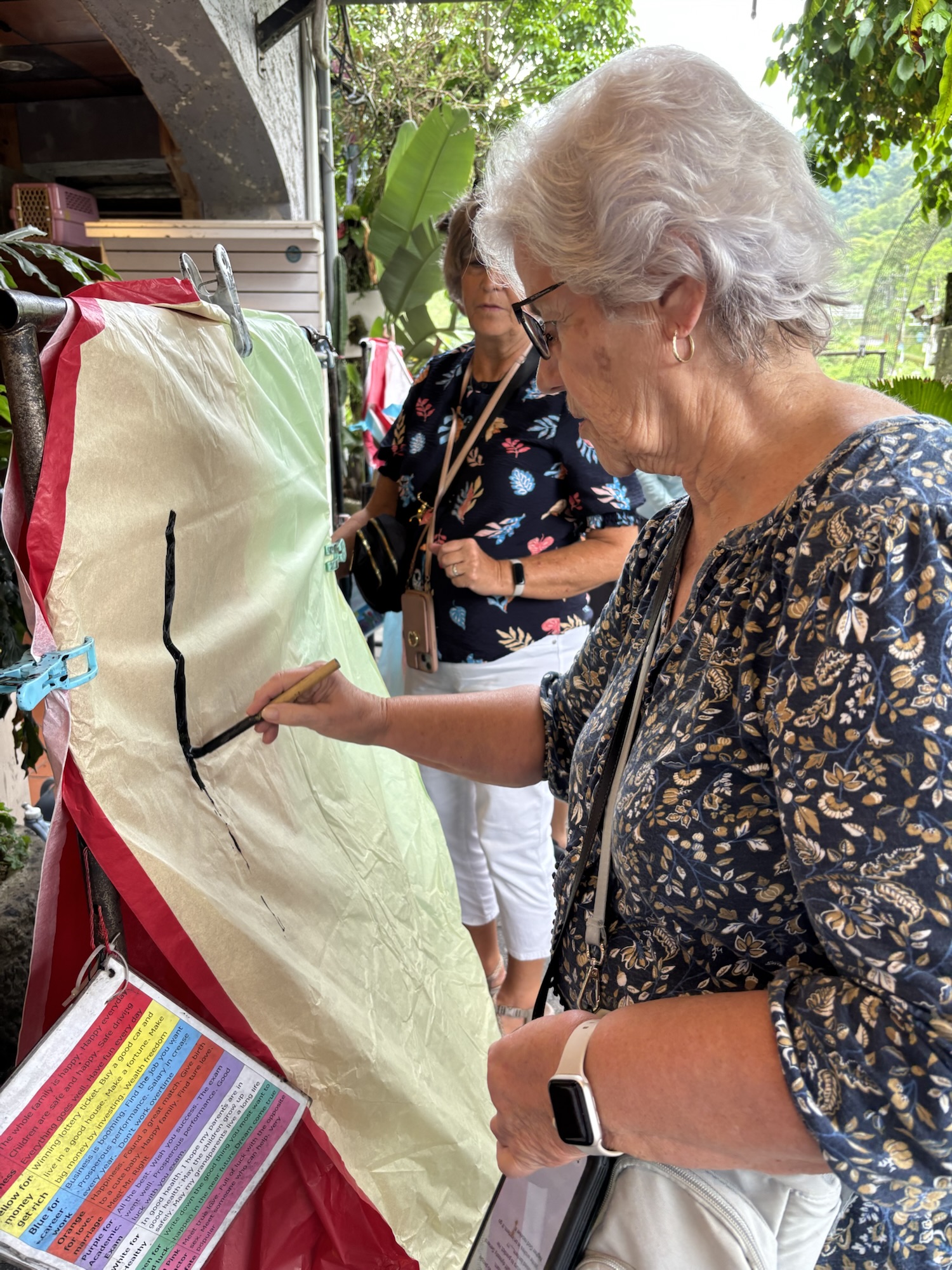
Later, this tradition was shifted to celebrate holidays and to pray for blessings. Now, crowds of tourists come into the village to write wishes on lanterns, which are made of paper and bamboo. These hot-air balloons ascend up, and supposedly the higher the lantern ascends, the more likely the wish will come true.
Vendors have set up shop all along the train tracks that run through the middle of the village to sell the lanterns, provide paint for the wishes, and help get each one launched safely. Because of resulting fires in the past, the government only allows this tradition to be done in this particular city, and everything is carefully monitored.


Our wonderful Easter in Tawain ended with a performance on board our ship of the Song Kun Performing Art Group with a dynamic song and dance show telling their ancestral stories. Afterwards, my niece and I went out on the deck to watch our final sail-away from this small island with such an important history and future.


As I look back on those two days, I recognize that I only had small, somewhat unbalanced tastes of this island country. I sampled one of their 10,000 temples, saw a unique waterfall, enjoyed seeing unusual food snacks, and sent a lantern upwards, but I never saw the mountains in the central part of the island, or the rice fields in the north and the sugar cane ones in the south, the modern high-rise tech buildings in the central business districts of the large cities, or schools, or parks.
Taiwan has so much more to offer than what I saw. However, I shall have to be content with my small taste of this strategic country.
Leave a Reply