
Eight fast-paced days in Japan – six ports including two with over-nights – how can I adequately share all that I experienced in that country as this trip continues to move forward quickly with more new port stops. I feel the pressure to write so that I won’t forget my experiences, while I also need time to rest from busy port days, prepare for the next stops, and enjoy the shore excursions we plan.
As I sit here with my laptop at a table on Deck 8 overlooking the calm Pacific Ocean, I realize I simply don’t have the time to share all about the places, people, and experiences of the eight days in Japan. All I can do is to pick one main memory from each port to record on paper, and allow the rest of the memories to fall back into the recesses of my mind to be thought about later after I am home.
I knew Japan was located on a few islands, but I sure didn’t know there were over 14,000 islands, with all but 400 of them inhabited! The islands stretch a distance similar to the distance between Maine to southern Forida with Russia and Korea to its west and the Pacific Ocean to its east. Most of the 125 million people live along the coastlines of the four major islands. Our port stops started at the southernmost island and ended at the northern one.
Snapshot # 1: Naha, Okinawa
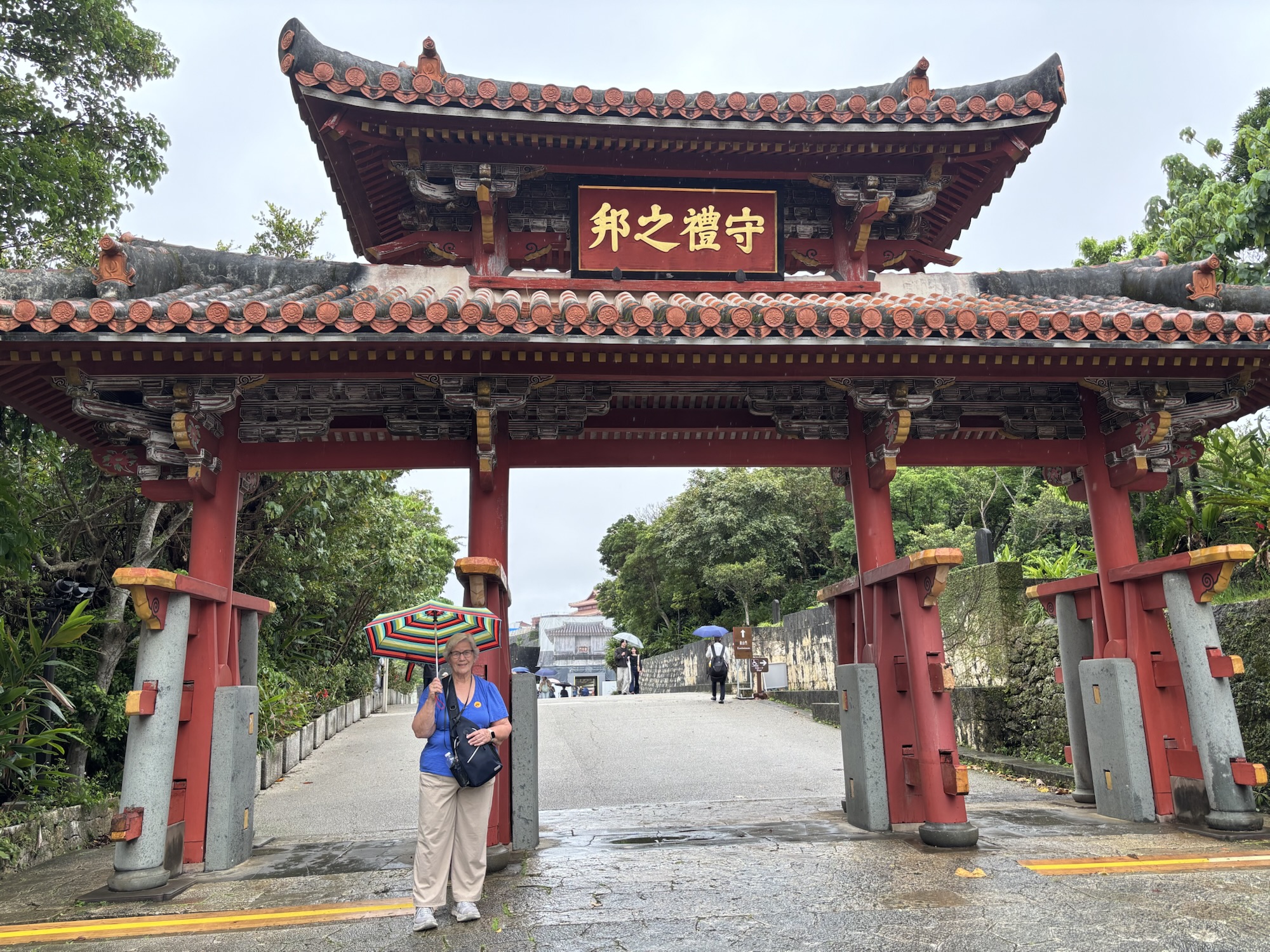
Naha is the capital city of the prefecture (like a state) of Okinawa. 90% of the island was destroyed during World War II, including most of the historical site of Shurijo Castle in Naha. This castle was built in the 1400s and was the royal residence for the Ryukyu Kingdom until the 1800s. The castle was reconstructed after the WWII, but was devastated by a fire in 2019. Currently undergoing further restoration, the castle’s rebuilding stand as a testament of the people’s determination to preserve what they can of this significant period of history.
Two gates are the focal points of my memory of this visit. The Shureimon Gate with its red and white tiled roof stands boldly as the symbolic entrance to the castle. This was the “welcome gate” where the visiting dignitaries centuries ago would arrive to meet the king after walking over three miles from the seaport. This gate, an iconic symbol to all Japanese, is featured on the 2,000-yen currency note.

The other gate was built in 1519 of coral limestone and is called the Sonohyan Utaki Shrine. It was on the north side of the castle area and served as a prayer spot for the king to pray for a safe journey whenever he left the castle.

built in 1519

Despite the rainy day in Okinawa, I enjoyed seeing the evidence of a time centuries ago when prosperous dynasties ruled this island that would later become part of Japan.
Snapshot # 2: Amami
Amami is the name of a group of eight inhabited islands in southern Japan as well as the main city on the main island. The highlight of my day-long trip to Amami City was a stop at the Oshima Tsumugi Fabric Factory where silk was skillfully dyed and woven in a 1300-year-old laborious process.
There are thirty steps in the process from dying the silk thread, hand-weaving the intricate patterns, and making a garment. The entire process can take six months to a year, and the resulting garment can last for two-hundred years because of the strength of the woven strands of silk thread.
The small family factory I visited gets its silk thread from either Brazil or China. The bark and branches of Sharinbai trees are cooked twenty times over a period of many hours to produce a tannin-rich pigment. The shanks of silk threads are then soaked up to twenty times in the reddish-brown bark water, getting slightly darker each time.


Samples hanging from the rod go from light to dark.
The final dying process occurs as the silk strands are washed in mud baths four times, wrung out thoroughly, and dried between each dipping. We watched a man laboriously doing this process, standing alongside the mud pit.

The combination of the protein in the silk, the acid in the bark, and the iron in the mud is what produces the permanent, unique colors of the silk threads and leaves the material with a soft, lustrous sheen.
The silk threads are woven manually on looms with vertical and horizontal threads forming intricate patterns in the fabric. These warps and wefts are dyed separately which is what makes the various shades to be used in the pattern design.

Our guide told us that it takes an apprentice three years to learn the weaving process and then ten more years to become truly a professional. Because of the tediousness of the weaving, it takes an expert weaver at least six weeks to produce enough fabric for one kimono.


Producing a kimono from the beginning of the dyeing process to the final garment can take up to a year. The final result is a lightweight, hand-woven silk kimono that can be used for generations. Obviously, these are costly garments. In the shop at the end of the tour, silk ties were $150, scarves $400, vests $500, and kimonos between $4,000-$5,000.
Whenever I think back to my day in Amami, a city I never had heard of before, I will think of the man washing silk thread in mud and the women deftly weaving an inch or two of silk per day with precision and care.
Snapshot # 3: Nagasaki
“Nagasaki must be the last place exposed to an atomic bomb,” read the sign in ten languages just inside the entrance to the Atomic Bomb Museum we visited on our first day in that city.
The mood was somber as I began walking on the spiraling hallway descending downward as though I was about to enter the bottom of a pit, the place of utter destruction. The moment of 11:02am, August 9, 1945 when an atomic bomb was unleased over the city by a B-29 bomber is frozen in time on a large clock found in a house near the hypocenter, or area of explosion, of the bomb.
I walked past displays showing photographs of the devastation, stopping to read the signs and to stare intently at the depictions of horror. And I felt revulsion and shock, and sometimes I couldn’t even take out my phone to photograph what I was seeing. I wanted to shut my eyes, to avoid seeing, but I couldn’t. I had to see in order to feel the loss, the desolation, the suffering.
And then there were artifacts, items left after the bombing that gripped me:

by the ferocious heat

died under the rubble of the building


The devastation wasn’t only the immediate loss of life (at least 65,000) and the destruction of homes, schools, and businesses, but also the aftermath of the radiation that caused long-term cancers and other diseases that appeared years later. And, of course, there was the psychological trauma endured by so many people that cannot be measured but was described in oral histories that we visitors could listen to.
After visiting the sobering reminders of that cataclysmic day, I next entered the 2nd part of the museum, dedicated to the current status of nuclear warheads throughout the world, the dangers of atomic weapons, and disarmament efforts.
A meaningful chart showed the actual number of nuclear tests by country to date. One long wall was an extensive photographic collection of those tests conducted throughout the world. And then there were thoughtful questions and quotes about peace and the need to strive for nuclear disarmament so that no area of the world would ever again experience what the people of Nagasaki did at 11:02am, August 9, 1945.

Our subsequent visit to the Nagasaki Peace Park close by was a relevant and necessary end to our day. The beautifully landscaped 46-acre memorial is on the land once obliterated by the bomb. The more-than 50 statues and monuments placed throughout the large park share their messages:

symbolizing the suffering and grief caused by the bombing.

the left hand extended horizontally represents peace,
and the lightly closed eyes represent praying for the souls of the atomic bomb victims.

who suffered from severe burns and thirst

and a symbol of the country’s oath never to cause war.
A never-to-be-forgotten day in Nagasaki, now no longer just a name in a history book, but a place where I felt both sorrow and hope. The simple but powerful words, “Pray for peace,” took on more urgency.
A day later, we left the Nagasaki Harbor, serenaded by a local high school band. I admit I had some tears as I leaned on the railing of the aft sea-deck and listened. These young people were 80 years removed from the horror of that day forever linked to their city’s name. Their grandparents or great-grandparents would have been alive at that time, but here these students were, playing at a grassy sea-side park, with probably nary a thought of the past.


What a reminder to me that life moves forward, with special moments in time where we reflect and remember so that we can go onward with resolve.
That night, Julie and I took a selfie on the deck with the night sky as our backdrop after our “dressy” dinner.


Leave a Reply