
Snapshot # 4: Shimizu
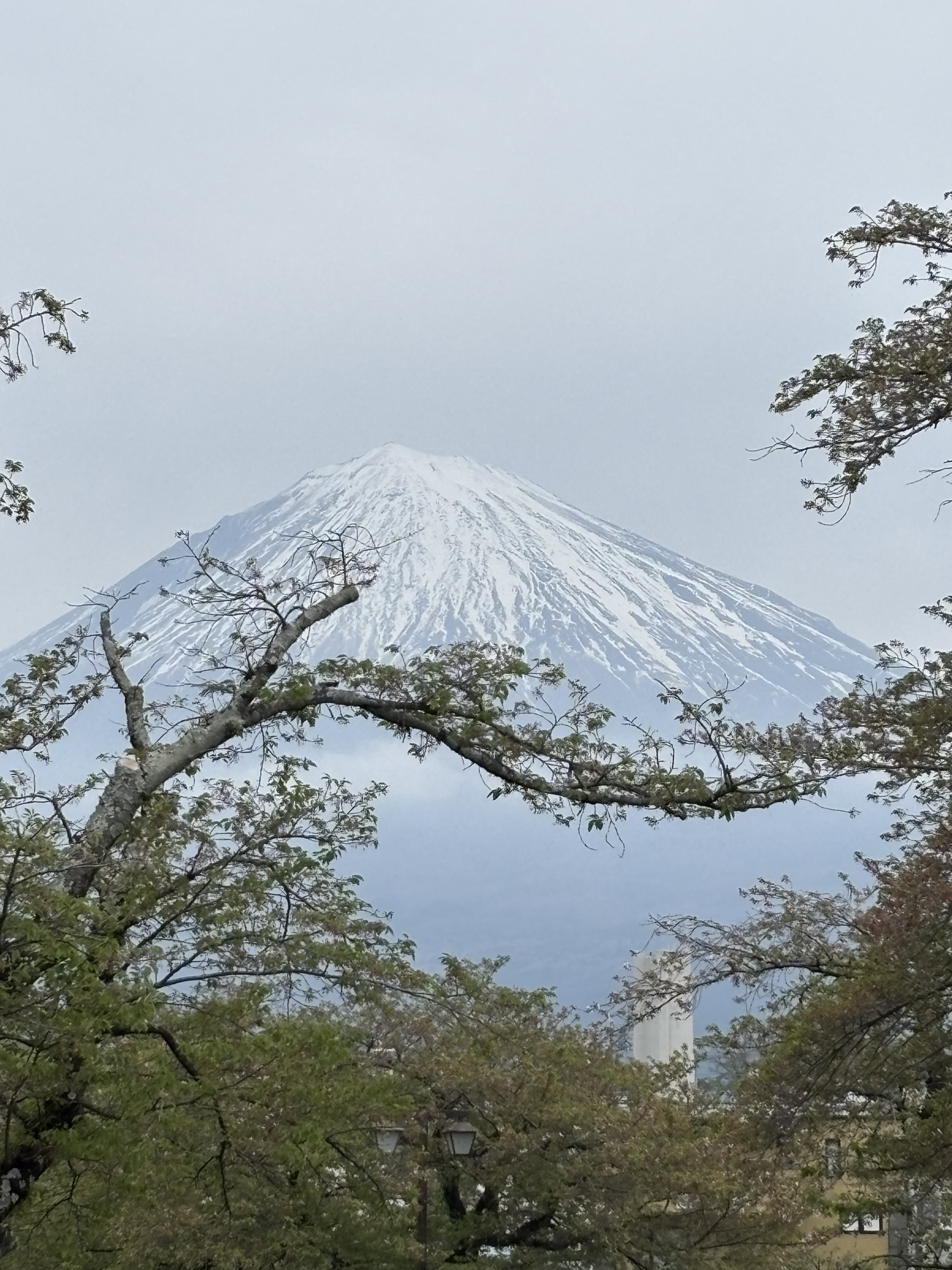
Shimizu, a port city about two hours south of Tokyo, was the 4th city of Japan that we visited. My special memory of this port was our visit to the Mt Fuji World Heritage Center for unobstructed views of this mountain which is considered a sacred symbol of Japan.
As our bus traveled past rice fields and though rolling terrain, the guide shared the various ancient myths and folktales about the formation of this mountain. In actuality, this cone-shaped mountain may be the combination of three other volcanoes covered by volcanic ash. Mt Fuji is Japan’s tallest mountain at 12, 389’ and is still considered active even though it has not erupted since 1707.
The Mt Fuji World Heritage Center is about 60 miles from the mountain itself, but this center provides an observation deck with clear views of the mountain if the weather cooperates. We were grateful for a clear day, and that the mountain was not “shy” and hiding behind the clouds, as our guide described it! Our guide also mentioned that Mt Fuji is now suffering from “over-tourism” because too many tourists and pilgrims climb its relatively mild slope and leave trash along the way.
The design of the center caught my attention immediately. It was designed in the shape of an upside-down cone so when it is reflected in the shallow pool in front, the reflection is the cone shape of the mountain itself! What incredible architecture!

Inside, I walked up a spiral ramp, winding round and round upwards with various exhibits in alcoves along the way. The various interactive displays shared the geology and history of the mountain, as well as explained the cultural and spiritual significance of the mountain to the Japanese.
At one point on the ascent inside, there were scenes on the wall from the mountain with moving shadows depicting hikers climbing the mountain. As I walked past a hidden light, my shadow was added onto the scene so it looked like I had joined the hikers!

What a stunning view as we ended the indoor “climb” and arrived on the observation deck!


My indoor climb through the Center and the views of the mountain from the observation area combined into this very memorable moment in Shimizu.
Snapshot # 5: Yokohama
Lots of guided tours were available to see the highlights of Japan’s second largest city of Yokohama, a major port about an hour away from Tokyo. However, we chose to walk around the port area and “see what we could see.”
Our super-fun discovery was the Cup of Noodles Museum where we spent four hours seeing the exhibits, making our own custom cup of noodles, and eating at the international noodle bazaar.

The whole instant ramen noodle industry started in a hungry country after WWII. Momofuku Ando, 48 years old at the time, saw the long lines of people waiting to get a bowl of noodles, and he wondered how he could help with the food shortage in Japan by making noodles that could be instantly prepared just with the addition of water.
Momofuku spent years trying various techniques and finally, with his wife’s help in their own kitchen, he discovered that flash frying the noodles first would keep them shelf-stable and easily reconstituted with water. The first packaged ramen was sold in 1958 as “Chikin Ramen.”
We enjoyed looking at the instant noodle history wall where individual packages of ramen were displayed chronologically as different flavors were developed. The industry exploded with the addition of international flavors and packaging.


In a theater room, we saw an animated movie showing how Momofuku overcame adversity to achieve his success, how he “thought outside of the box” to figure out, for example, why and how to package “cup of noodles”.
He found that forming the noodles into a round cylinder and placing the empty cup upside down on top of it, then inverting the cup before sealing it was the solution to making sure all the noodles reconstituted evenly. His method left an inch space in the bottom of the cup as well as on top of the noodles, so the water added later would heat the noodles from both the bottom and the top.
The museum is also a place for people to practice creative thinking aided by Momofuku’s philosophy. Each of six rooms had displays and words on the walls to spur creative thought based on his key thoughts:
- Discover something completely new (what the world hasn’t seen but would be nice to have)
- Find hints in all sorts of places
- Nurturing an idea so the invention is for everyone
- Look at things from every angle
- Don’t go with the status quo
- Never give up
I really liked this quote by him I saw on one of the walls: “After failing in my business and losing everything I had, I made a fresh start at age 48. People often say that my start was very late, but in life, there is no such thing as “too late”. You can find challenges from the age of 60 or even 70.” And he kept going in life, inventing ramen that could be eaten in space in 2005 when he was in his 90s!
Of course, a fun high-light was creating our own cup of noodles to take home. First we were given an empty cup to design with our name and any other identifying marks we wanted. An assembly line was set up with employees properly garbed behind plexi-glass. They took our cup, and put it through a conveyer to get inverted, dropped over a clump of ramen, and turned back right side up.


Then the employee added the ingredients we chose — various seasonings and dried meats and veggies. A lid was placed on, and each of us could turn the crank as the cup went through the sealing process. End result? A cup of noodles I’ll take home and enjoy!


We wanted to end with a meal in the Noodle Bazaar. The sign challenged us as did the method of payment! Turns out we had to put yen coins into a machine to get a ticket which we could then take to one of the eight booths in exchange for an international ramen noodle dish.
Our choice? I picked Tom Yum Goong Noodles from Thailand, a ramen soup with lemongrass, lime, and coconut milk! And would you believe that the dessert on the right is “chicken cup-of-noodle-flavored soft-serve ice cream with toasted bits of ramen”? Tasted pretty good actually!


What a quirky, rather charming memory of a bustling port city!
Snapshot # 6: Hakodate
Our final port-stop in Japan was Hakodate on the northernmost island of Hokkaido. My niece and I decided to give our legs a good work-out before the next seven days on the ocean, so we planned a walking tour to see some key sights.
After walking to the water-front fish market, with all the sights and smells waking us up, we enjoyed a Japanese breakfast at a food stall. We mapped out the route to the Mt Hakodate Ropeway, a gondola ride to the top of the mountain, and began the journey of way more than a thousand steps to the ropeway’s lower station!
I’m thankful that Julie paced herself to my pace, and encouraged me along the way, especially when we got to this sloped walkway. It may not look that steep in the photo, but my legs and hips felt the incline at every step.


I enjoyed the ascent of the gondola as it rode smoothly up to the mountain summit in less than five minutes. The breath-taking, panoramic summit was a wonderful reward to our morning walking adventure.
The scenic muti-level observation area was not crowded so we took our time looking out over the city and Hakodate Bay, as well as the Tsugaru Strait on the other side.


“When it’s crowded, please be considerate of others.”
Julie had heard about Cape Tachimachi, a scenic viewing point near the mountain, so we rode the gondola down the and arranged for an Uber to take us the few miles there. What a spectacular view of the rocky land jutted out into the Tsugaru Strait! We walked along the cliff on a safe, fenced path, enjoying the view, smelling the fresh air, and feeling the ocean breeze.


We were delighted to see a small food stand near the parking lot, and counted the Japanese currency we had left to see what we could order for lunch. The cook was frying some food, so we pointed out what looked good to us, quickly adding the yen listed for the prices. We ended up with a “sausage” that looked like a hot dog, a skewer with a few scallops, and one with potato slices.
We loved sitting at a rather old picnic table overlooking the water and enjoying this simple snack.


But what really made us laugh was the “Google Translate conversation” we had with the cook afterwards.
The scallops had been especially tasty, and we wondered what they had been wrapped with before being cooked. We knew it wasn’t bacon! Julie wrote the question on her phone in Google Translate, and turned the phone towards the cook. He looked puzzled as her question was translated into Japanese, then smiled, took out his phone, and wrote a one-word answer in Japanese characters.
When Julie read his answer translated into English, the word was “ovaries”. We tried not to laugh in front of the dear man, but we sure did when we turned away and continued our hike! Either Google Translate goofed or we ate something we hadn’t intended to eat!
Being really tired, we arranged for a taxi to come pick us up to take us back to the Volendam. The cab was boxy and cute, inside and out. And the lady driver sported a jaunty cap, white shirt with black vest, and white gloves! What a stylish way to ride to the ship!


The view from the mountain top and our delectable lunch tucked a great snapshot in my mind of Hakodate that will always provide a memory of beauty and of a hearty laugh.
We left our memorable time in Japan and headed out to cross the North Pacific Ocean for seven days of winds, waves, and a Bering Sea storm with Kodiak Island, Alaska as our destination. But that’s the topic for another day!


Leave a Reply