
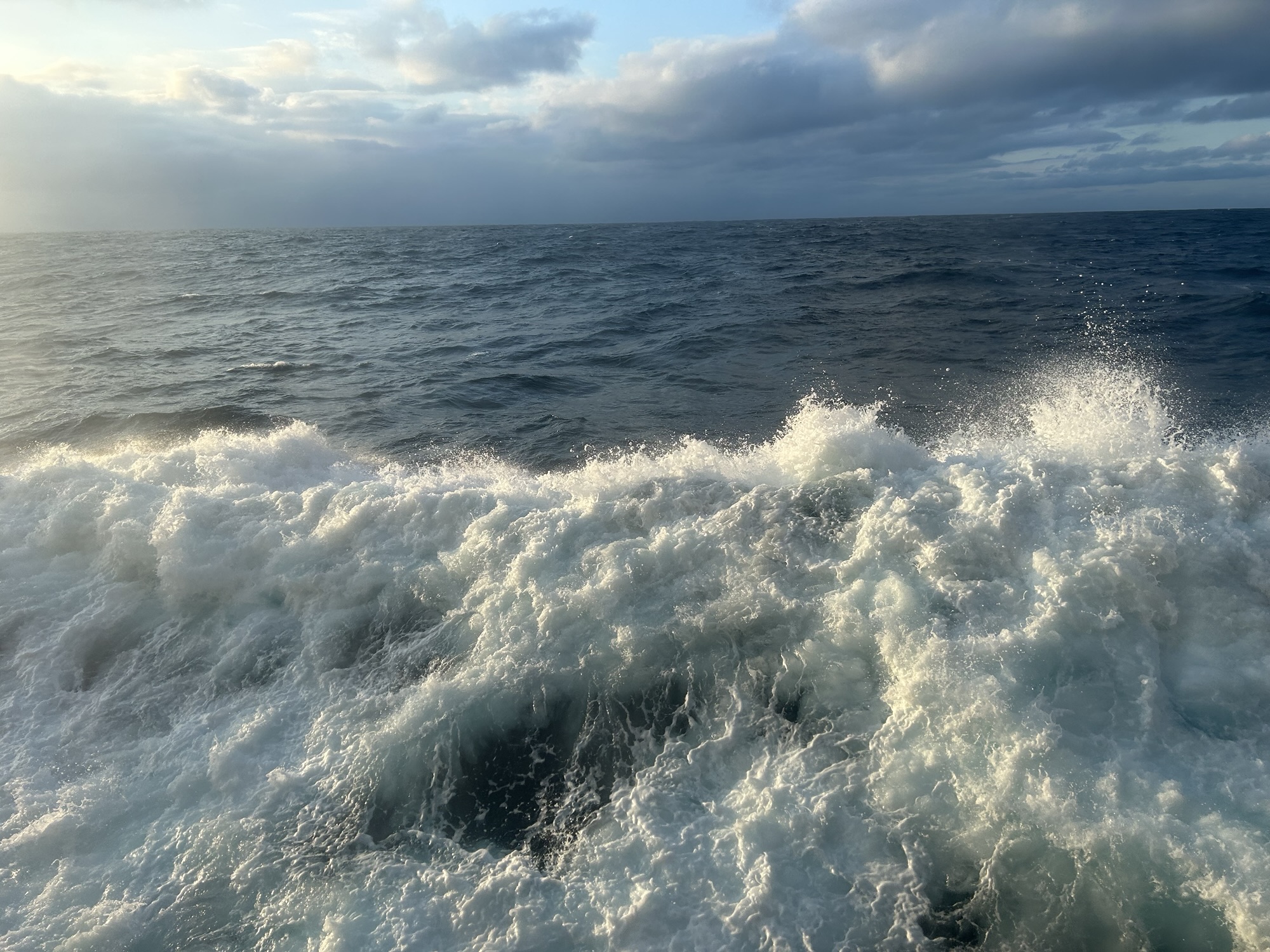
As we left the port of Hakodate, Japan, I looked forward to our seven-day trans-Pacific Ocean crossing to Kodiak Island, Alaska without seeing land. I hauled my “winter clothes” suitcase from under my bed, and switched out my short-sleeve shirts and capris with my jeans, sweatshirts, and parka to be prepared for the changing weather.
Looking forward to long days of catching up on my blog-writing and video-production, I was unprepared that my activities would need to be done on a ship caught in a North Pacific storm as we followed a “Great Circle” route to our destination.
Our skilled Captain gave us daily updates on his 12:00 noon intercom briefings. I learned all about the “Beaufort Scale”, a number between 0 and 12 used to define wind speed, wave height, and sea state with a “0” being a calm sea and a “12” being a hurricane. He told us there were three possible routes to use, and the navigation team, using all possible resources, would advise the safest route.
We heard reports telling us, for example, that the seas were “moderate” with 14’ waves but the next day we would be experiencing 27’ waves. The words “gale-force winds” and “confused ocean swell”, and “heavy weather expected” meant we had to hold onto hand rails when walking the hallways and be extremely careful in the shower, constantly holding onto a grab bar with one hand while washing with the other. All outside decks were closed for walking, of course, which meant I needed to get my daily 3-mile walk in throughout the interior of this ship I called my home!
About mid-way in the week, our captain navigated the ship north of the Aleutian Islands into the Bering Sea to seek some shelter from the relentless wind and waves. Even there, sleeping meant more than feeling the gentle movement of the ship that usually lulled us to sleep and kept us asleep. Instead, sometimes I woke up with the sudden rolling or pitching of the ship as waves hit the side or as we went headlong into oncoming waves.
And then there was the creaking of the ship we could hear throughout the day and night as we went through the worst of the storm. The waves came up on our 1st deck window and we heard the “groaning” of the ship as it was put to its test. I took a few videos so I could relive these moments when I was back on dry land!!

The sturdy Volendam, on cruising duty since its launching in 1999, weathered the stormy weather just fine, and so did I. It was one of the memorable parts of this adventure, to see the power of the wind and waves, and to feel protected inside the shelter of this fine, old, reliable ship!
I never got sea sick in all that motion of the ocean!! The ship had green apples, ginger chews, and ginger tea available, and I had prescription meds for seasickness in my Rx kit. But I am thankful I didn’t need to use any of that.
Of course, the multiple time-changes were another challenge on this 7-day crossing. Not only did we have to turn our clocks ahead one-hour per day for six consecutive days, but we also crossed the International Date Line, and moved the calendar back a day! Yes, we had two April 20s! The 2nd April 20 made up for the Feb 27 we never experienced when we crossed that imaginary line heading west. My body was confused with altered sleep cycles!
After all that excitement, it was wonderful to come to our first port-stop in Alaska, Kodiak Island. I felt like a kid let out of school for spring break! It felt so good to be on land. I admit I was a bit emotional. Hearing the U.S. Immigration & Customs officer say “Welcome home!” and setting foot on U.S. soil after almost four months away was absolutely wonderful! And knowing I could use U.S. dollars instead of figuring out foreign currency rates was comforting!

Due to the scheduling of this Grand World Adventure, our ship was the first cruise ship of the season on Kodiak Island, and tour guides were grateful for the start of the tourist season. This island, the 2nd largest in the U.S., has a total population of about 12,00 people and 3,500 Kodiak brown bears. It also is the home of the largest U.S. Coast Guard base.
I boarded a school bus for my Highlights of Kodiak tour and sat on a well-worn leather seat meant for kids! We first traveled to the Alutiiq Museum which traced the history of the Alutiiq tribe of Alaska natives. Built with settlement money from the Exxon Corporation after the Valdez oil spill, the museum displays ancestral artifacts and shares how Alutiiq traditions are being restored and preserved.


A heart-breaking display was about the journey to discover what happened to the eleven students who were forcibly taken from this native community to the Carlisle Indian Industrial School in Carlisle PA in 1901. This was a U.S. government program that tried to assimilate native children into American Society and suppress their indigenous language and culture.

Across the road was the Russian Orthodox Church, built in 1945 to replace an old one that burned. What caught my attention was the bald eagle perched on the cross.


The Kodiak History Museum was located in Alaska’s oldest log building built in 1808. Inside were exhibits from the time Russia owned this area. Did you know that the U.S. purchased Alaska from Russia in 1867 for $7.2 million dollars, or 2 cents per acre?

Around the town, I noticed unique trash cans, bear-proof, designed to look like cans of salmon! Of course, salmon fishing is the primary industry in Kodiak which creates thousands of jobs on both the fishing boats and in the processing plants.


Our tour ended at Fort Abercrombie Historical Park. Situated on the eastern shore of the island facing the Gulf of Alaska, this park has spruce forests, hiking trails, and bluffs overlooking the ocean. We stepped out of the school bus and walked through a forested area with moss growing on tree branches and covering the forest floor.

We had free-time to walk along the cliffs to view the remnants of the gun fortifications built in 1941 as a defense against a possible Japanese attack. The Kodiak Military History Museum was tucked inside an old restored ammunition bunker nearby.


as part of the WWII defense system


Back on the dock, I had to walk down this steep gangway to the tender to take us back to the Volendam.

Once back on board the ship, I went up to the Seaview Pool area on Deck 8 to watch the Sail Away. I stopped to take a photo of the “Brian T”, a local tugboat ready to assist us out of the harbor.


It was at about that moment that I felt my first bit of homesickness. I heard the distinctive thumping sound of a helicopter, looked up, and saw a Coast Guard search and rescue helicopter overhead.
I was too surprised to open up my phone to take a photo, but I suddenly felt this longing to see my family. The helicopter instantly reminded me of my granddaughter, an officer in the U.S. Coast Guard who was stationed on Kodiak Island a few years ago, and that quickly morphed into missing all my children and grandchildren.
As I watched that helicopter fade away into the horizon, I was glad I’d be seeing my family in about three weeks. I guess feeling homesick for the first time on Day 112 out of 133 days wasn’t too bad!
So full speed ahead to the next two Alaska ports and the adventures that await!


Leave a Reply