
There’s something special about being the first cruise ship of the season in an Alaska town plus being the only one docked. Streets were virtually empty, there were no lines in restaurants, and the shop vendors and tour guides “still liked us!”
If you’ve ever been there during the peak-season of July and August, you probably experienced large crowds and long lines from 3-4 ships that may have affected your enjoyment. The Volendam had the honor of being the first and only ship docking in both Sitka and Ketchikan.
SITKA, ALASKA
I was impressed with the Sitka Sound Cruise Terminal located about five miles from Sitka with its welcoming wooden eagle statue and accessible shops. To accommodate thousands of passengers that spend a day in Sitka in the summer, this modern terminal was built in 2012 and is the hub for the mandatory shuttles that take guests back and forth to the town.


I had signed up for a “Sea Otter & Wildlife Quest” boat excursion so I was routed directly to the waiting small expedition boat that would navigate the water passages surrounding Baranof Island, home of Sitka. This island, located west of British Columbia and part of the Alaska Panhandle, was the site of the Alaska Purchase Transfer from Russia in 1867.
The day was cloudy, cold, and overcast as we headed out into Sitka Sound along the barrier islands. I was bundled up in my parka, hat, and gloves, and was still cold as the small boat navigated the waters. The naturalist aboard shared a lot of fascinating details of the lives of sea otters, eagles, grey whales, and sea lions as he, the captain, and all 20 passengers scanned the water and island shores for wildlife.
We were not disappointed. Our wildlife quest resulted in seeing all that the tour ads suggested we maybe would see. But unfortunately, my photos didn’t catch the activity I saw.
Because much of the wildlife is protected under the Marine Mammal Protection Act, close approaches or fast-moving boats are prohibited. Since we were limited in how close we could get, and the water and sky were both grey, sea otters and whales are indistinguishable blobs on my photos!

Green buoy helps signal where boat can safely travel.
After a lot of unsuccessful photo shoots, I relaxed, packed away my phone-camera, and enjoyed what my eye could see and my mind remember.
I learned that a group of sea otters is called a raft. Each sea otter has one-million hair follicles per square inch which makes its fur extremely dense. That’s why they can float so long in cold waters and stay warm, and why their fur was desirable for hats and parkas by the natives and later the Russians. Sea otters also have a pouch under their arm-pits where they store extra food and a flat rock. They use that rock to help them smash open hard-crusted sea urchins for food!

We saw numerous grey whales on their migration route from Baja California to the Bering Sea, a distance of over 7,000 miles each year. The calves are born in Baja, and when they are about a month old, the migratory journey begins with the mother whale. They arrive in Sitka Sound when herring are laying their trillions of eggs. This becomes food for the whales that can eventually grow to 9’ and weigh 9,000 pounds.

Sitka Spruce trees abound in this area and are used for pianos and violins because of the excellent sound vibrations. The wood is also used for boats and air craft wings.


After my two-hour boat excursion, I took the shuttle into town and met up with my niece. We visited the old Russian Orthodox Church, St Michael the Archangel Cathedral. Built in the early 1800s, it burned down in the 1960s and the current one was built at that time. It is filled with Russian icons and vestments salvaged from the fire.

but the weather didn’t cooperate for a good photo!
Across the street, we were delighted to find a local restaurant serving Russian “pelmeni”, a boiled dumpling filled with meat or potatoes and served with sour cream. I eagerly sent photos to one of my daughters who had spent a year of college in Russia years ago.


After visiting a few shops on the main street, we walked back to the shuttle stop, arrived at the harbor, and boarded our ship.

We had the town to ourslves!
KETCHIKAN, ALASKA
I love it when our ship opens up the bow on Deck 4 in the morning as we enter a port. The staff even serves coffee, juice and rolls, this time “Ketchikan Rolls”!


The main town-square was virtually empty as we disembarked our ship and headed down the neighboring pier to go aboard the “Aleutian Ballad” for an excursion that proved to be way beyond my expectation.

From the moment I got on the 100’ long boat until I stood on the gangway for a departing photo with a crew member three hours later, I was awed by what I saw, heard, and experienced. It was indeed a once-in-a-lifetime experience.
The ship gained its fame in Season 2 of the Deadliest Catch when a rogue 60’ wave hit the ship which miraculously survived. After its last crab fishing season in 2006, the ship was remodeled so tourists can have a hands-on experience alongside a crew of seasoned fishermen.
Although there are sheltered stadium seats on the lower deck, we were encouraged to move around the ship to watch and participate. Captain David Lethin, a Bering Sea commercial fisherman for 47 years and owner of the ship, was at the helm. The main crew members were David T and Big D, both of whom worked decades on the treacherous Bering Sea.
Throughout the day, the crew members shared their dramatic stories of fishing in the Bering Sea as well as educating us about the amazing marine creatures that were caught during the day.
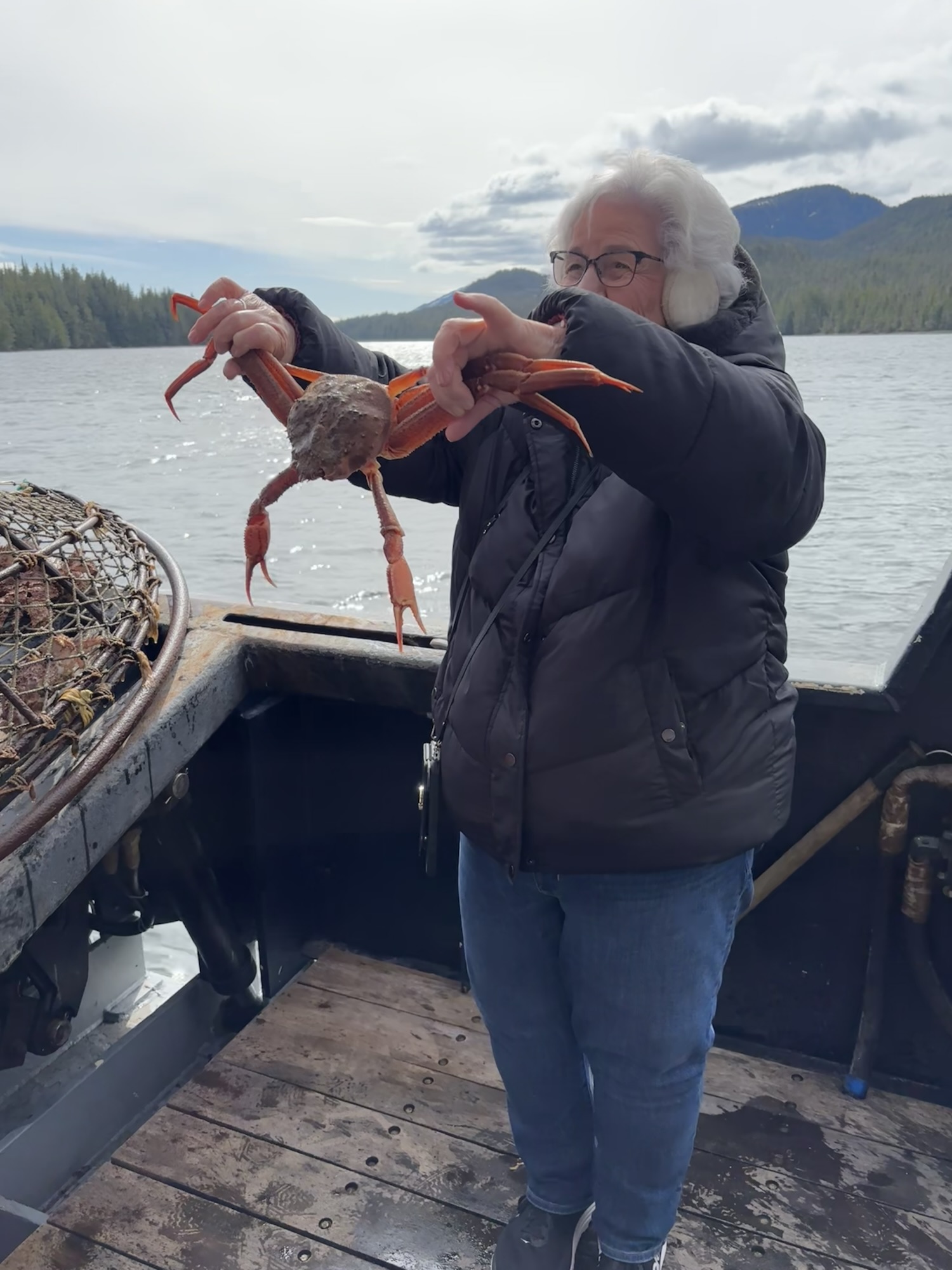
Each day the crew set out long lines, crab pots, shrimp pots, and an octopus barrel, all marked by buoys with the ship’s identification marks. During the tour the following day, the lines and pots are pulled in and the catch examined. We were able to see and examine everything before the catch was released back into the water.
Rather than using words, I’ll let the photos of the day tell the story:


or sight-seeing on the upper.


One of the highlights was seeing over 30 bald eagles soaring and swooping down around us when we were in a secluded inlet near Annette Island, the native home of the Metlakatla Indians.
The island is home to hundreds of bald eagles, and under a special agreement with the native people, this ship is allowed to slip into the inlet quietly to watch the eagles feeding. Seeing these raptors up close and seeing them dive to get food was breath-taking.

The excitement of the day was seeing and touching a 35-pound octopus! Those of you who know about my making videos for Cabrera Christian Classical Academy in the Dominican Republic understand why! This slippery, live octopus didn’t look anything like the blue-crocheted Odysseus that introduces the ports in my videos! By the way, there are over 25 videos on my web site that include Odey if you want to see him!


They are used for moving, sensing the environment, and hunting.


I’m holding an auto-graphed copy of the book written about the Aleutian Ballad, its history, and its crew.
It was rather anticlimactic to walk around Ketchikan after the excitement of the morning. But seeing the empty streets, and being able to walk along Creek Street without hordes of tourists turned into a fun afternoon.


As our ship pulled away from the Ketchikan dock, I resolved to find the You Tube video of the Deadliest Catch episode that brought the Aleutian Ballad its fame.
Of course, in my mind, this trusty boat is memorable simply because it took me on an adventure unparalleled to anything I have done before. I saw, touched, listened, and learned about the arduous and dangerous way of life of those who help bring fish to my table. And I touched an octopus!


Leave a Reply