
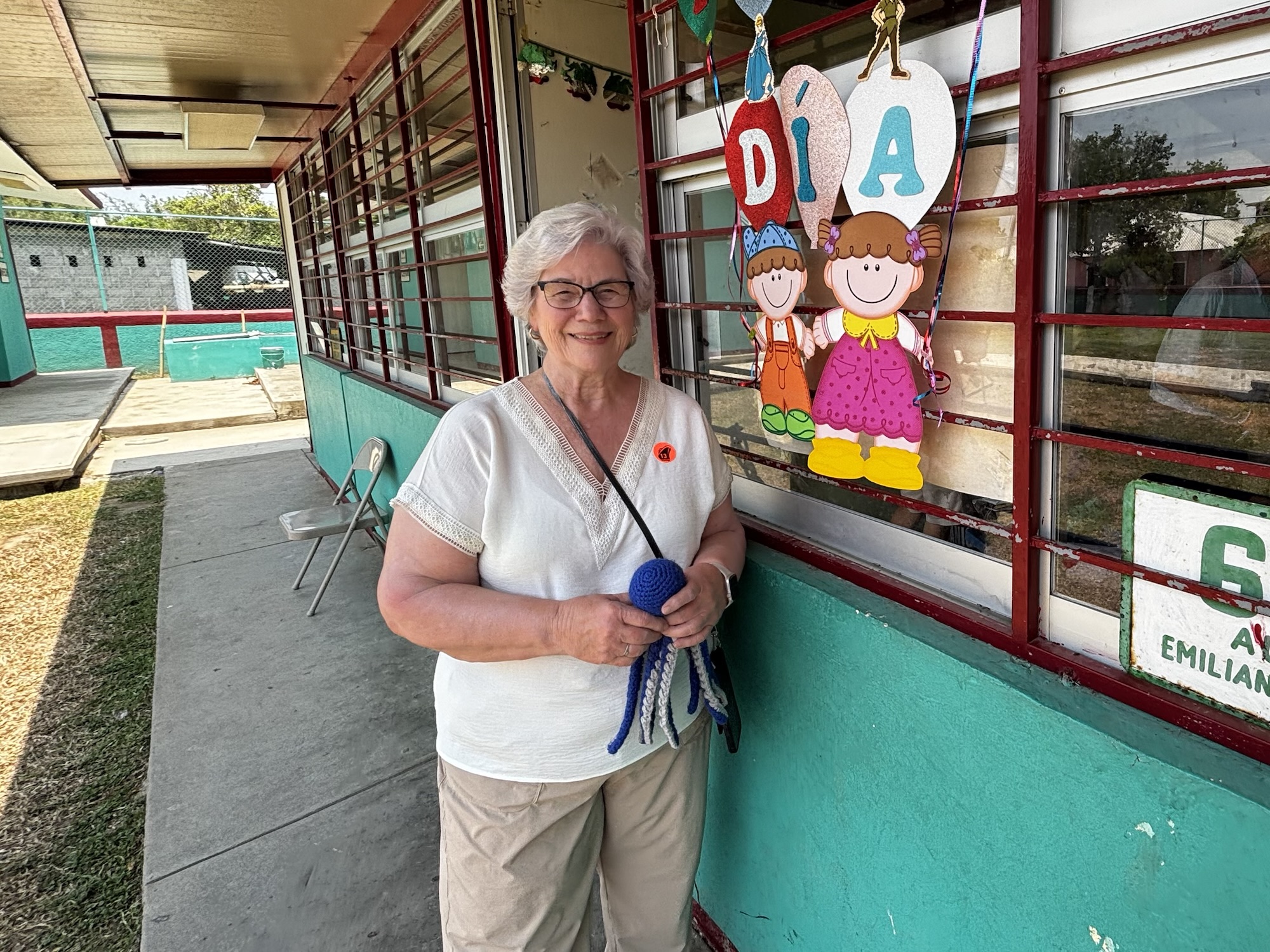
I was in my “happy place” on a very hot, humid Friday in early May. O, not the heat, but the place. Along with some other cruise passengers, I visited a rural school in Mexico near the Guatemala border where I interacted with elementary school students, hugged and got hugs back, and even danced with a 9-year-old young gentleman during the final program. My grins on the photos are proof I was indeed having a wonderful time!

Months before this adventure, my niece and I had seen one of the ship’s excursions listed for Puerta Chiapas, Mexico, and it beckoned me. The all-day outing would be to visit an elementary school and then go to a banana plantation, both run by a farming cooperative.
The morning of our arrival in this coastal agricultural Mexico town, I packed my “day bag” complete with sunscreen, plenty of water in my refillable bottles, tissues, protein bar, sunglasses, and, of course, Odysseus. If you don’t know who that is, check out the “Where in the World is Odysseus” section of my web site!
The cruise terminal was uniquely designed, and included a covered craft market. The port was upgraded from a small center for fishing and agricultural ships to a more modern one to attract cruise ships and heavier cargo to bolster the economy of one of the poorest areas of Mexico.

Originally I had been concerned about our safety since this area was considered “Level 3 – Reconsider Travel” by the U.S. Department of State. I talked to Holland America’s shore excursion team and was reassured that the cruise line takes the safety of its guests very seriously and wouldn’t have offered this excursion if it was unsafe.
My concern was alleviated when our bus turned onto a gravel road ten minutes from the port, and a “Guardio Turismo” car pulled in front of us to be our guard for the entire day. Our guide explained that the current governor wanted to ensure that tourists felt safe, and so he instituted this guard service.

As we traveled to the school, our guide explained that Ejido Miguel Aleman is a very successful collective plantation that was organized decades ago as part of Mexico’s Agrarian Reform when landless farmers received a plot of land distributed from large estates. Fifty-one farming families joined their land together, and the community works together to grow and pack bananas.
Profits are shared among the community members who are highly organized and work together for the common good. The members live in a town they built plus they support the schools, including the one we were going to visit.
The guide told us that the education is good, and students graduate and go to major cities for college and university. Some do not come back. As a result, the “collective” currently uses some workers from Guatemala whose border is only 360’ away from the edge of the plantation.

Ejido means “communal lands”. Miguel Aleman was the president of Mexico from 1946-1952
and this communal plantation is named after him.
As we entered the town, I was impressed with the neat streets, the colorful cement-walled homes, the kindergarten school, and neighborhood playground. This was so different from some of the other run-down, small towns we had driven past to get here.


Unfortunately, I wasn’t able to take a photo of the school’s entrance because the 25 of us were ushered rather quickly into the large, open-air central “auditorium and gymnasium” where chairs were set up for our orientation. But I did quickly get a photo of a sign inside the hallway to the meeting place.

Our guide told us the kids were excited we were here, that we would be visiting a 2nd grade room as well as a 6th grade one, followed by a program back in this central area. The gifts of school supplies we had brought would be given to the principal who would give them out as needed.

the bags of candy we would be handing out to the kids!
Now I don’t know Spanish, but it’s amazing how a smile and hug can communicate a lot! In the 2nd grade room, I saw a young boy working on a math paper. I only knew the first few words of counting, so I pointed to the numbers and said, “Uno, dos, tres”. With a huge smile, he kept on counting. Looking into his delighted eyes fed this old teacher’s soul!

Smiles and hugs were everywhere in that classroom as we visitors interacted individually with the 2nd graders. And no translation was needed for those universal signs of connection!

I had previously shared with the guide about my doing classroom videos for Cabrera Christian Classical Academy in the Dominican Republic while on this trip and asked if I could at some point in the visit bring greetings to the students from “my school”. I sure enjoyed telling the kids in the next classroom of 6th graders about Odysseus and the videos while the guide translated my words!


Each of the students in both classrooms had made something to give one of us. My treasured gifts hang on my home’s entrance-way wall so that every day I am reminded of those precious children who gave and received my hugs that crossed a language and cultural barrier.

Our last stop at the school was for a final program put on by the students. We sat on chairs on one side of the open-air auditorium, and students sat on the other three. After a welcoming talk from the principal, I was asked to share with the whole school about my adventures with Odysseus and bring them greetings from “my school.”
Then, dressed in colorful costumes, some of the 6th graders delighted us with multiple dances in a traditional celebration of their heritage. I took lots of videos so I would always remember the lively dancing and the energetic sound of guitars and drums.


As the last song ended, the dancers walked towards us in our chairs and invited us to dance with them! Of course, I have no photos to prove how well or poorly I danced, because all of us were having fun with the kids! But maybe this photo of my dance partner is convincing enough that I loved it!

Back on the bus, I was content to just sit in my seat and reflect on my amazing morning. But there was much more to see – a working banana plantation on this “communal land”.

The bus stopped about ten minutes later as we arrived at the entrance at the 500-hectare banana fields. A team of men surrounded the bus spraying all the tires of the bus with a disinfectant before we could disembark. When we got off the bus, we had to walk over disinfecting pads before entering the growing area.

Our guide led us to rows upon rows of trees and told us the growing cycle of this fruit that I enjoy almost daily. Did you know that, technically, bananas do not grow on trees? The “tree” is really an herb, because the “trunk” is not wood, but overlapping leaves!
The growth cycle is amazing and very predictable. When a new grove of bananas is started, a baby plant is put into a hole. In just six months, it is an adult plant, 20-40’ high, and produces a large, cone-shaped purple flower called the banana heart. Inside this “heart” are little flowers that develop into small fingers (bananas). Over the next three months, rows of small bananas develop, facing downwards at the beginning due to gravity.

But then something quite wonderous happens! While trying to find light, the “fingers” begin turning upwards, all the while fighting the pull of gravity! Light wins! And the bananas end up with the bottom ends turned upwards! This takes a few weeks while the fruit is still small.
The developing bunch is covered with a blue plastic bag to protect against harsh weather and pests. It’s blue because that prevents harmful ultra-violet rays from damaging the fruit plus keeps in the right amount of heat for healthy growth.
The bunch of bananas is cut off with a machete by a team of two men and hung onto conveyor belts which travel to the packaging building. At this plantation, only young men age 18-35 are allowed to do this difficult job because the bunches can weigh close to 100 pounds. They add a protective thin, foam, “banana pad”, interwoven throughout the cluster to prevent any damage to the banana skins.

Note the black line and the red arch of the conveyor support system.
After the cluster of bananas is cut off, this “mother” plant dies and must be cut down. But at its root, a “daughter” tree has already started growing which, after nine months, will have a fully-developed banana cluster. And, in an everlasting cycle of life, there is also another tiny shoot starting to grow out of the root clump, call the “granddaughter”. This cycle can go on, year after year, with every nine months a new “offspring” of the original plant producing a huge banana bunch.

It’s a “teenager”, per our guide!

awaiting its time to grow and produce its huge cluster of bananas.
The crew in the packaging plant were nearing the end of their shift as we arrived, but we were able to see the packaging operation for these Chiquita bananas destined for a Dole delivery truck.


(called a “hand” of bananas) and tosses them into this disinfecting pool.


The next group of ladies pulled the bunches out of the water and arranged them in three rows on a black plastic tray, large ones in the front, medium in the middle, and smaller bananas in the back. The goal was to have each tray weigh 18.6 kilos, approximately 42 pounds for each box that would be shipped. Due to experience, the weighed trays always were in the right range!

Fingers fly fast!

Each tray was then packed into one box and sealed for its one-week trip to the market for sale. Typically, the bananas are shipped to various ports in the U.S., and then distributed inland via trucks.

and to be loaded onto a truck. headed for a port.
As I left the plantation for the bus ride back to the Volendam, my first thought was, “I wonder if my local Meijers store gets its Dole bananas from this plantation?” And then, I smiled, thinking, “Wow! I’m surprised bananas aren’t more expensive in my store!”
After seeing all that’s involved getting a banana from a place like this to my table, I’m getting a bargain! A healthy snack with potassium and fiber for less than a quarter! I have a feeling that every time I eat one, I’ll remember this time and place!
What an amazing, delightful day. Kids and bananas. A little taste of Mexico!
Leave a Reply